Coffee and Wheat - Some Consume, Others Collect
- by Michael Stillman
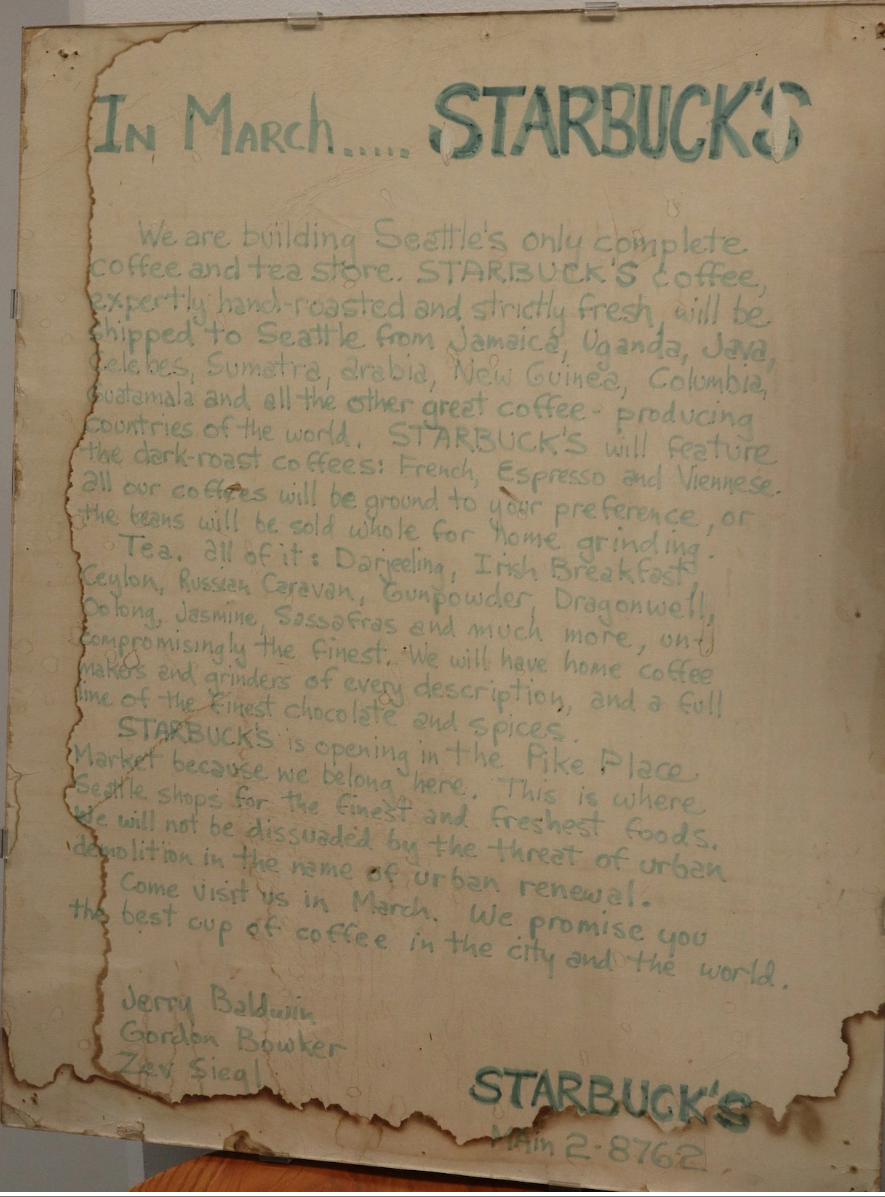
The original Starbucks Manifesto (UC Davis photo).
What is the first thing you do in the morning? For many of us, before going to work, recreation, or developing our book collection, it's to have a cup of coffee. However, it's unlikely you think much about it. You don't have a coffee-related collection and probably didn't know such a thing exists. It does, and it's not just someone's private collection. The University of California at Davis has a Coffee Center in its College of Engineering. It offers both undergraduate and graduate level courses. You can conduct experiments and learn all sorts of things about coffee. The Coffee Center describes itself as “the first academic research and teaching facility in the United States dedicated entirely to the study of coffee.”
Naturally, the UC Davis library has a coffee collection. Recently, they received three private coffee collections as gifts. One came from Gerald “Jerry” Baldwin, a co-founder of Starbucks and former President of Peet's Coffee. It includes material from the coffee seller's origins, including a manifesto displayed outside the original Starbucks, its first guest book signed by many of the founders, their family and friends, early financial records, early scrapbooks and photographs, and tasting score sheets. Other items show how Starbucks' three founders' quest for a great cup of coffee helped to shape the specialty coffee movement. Baldwin said, “My hope is people who are interested can turn to these documents as a reference and understand what it was truly like at the beginning.”
A second collection came from Russ Kramer, President of coffee importer Hacienda La Minita and veteran of Green Mountain Coffee. He worked with companies such as Dunkin' Donuts, McDonald's, Panera Bread and Safeway to develop coffee programs. His collection contains material covering sourcing, international trade, agricultural, economic and cultural dimensions of coffee and the trade. It includes Le bon usage du thé, du caffé, et du chocolat pour la preservation & pour la guerison des maladies, a 1687 French book about the curative powers of coffee, tea and chocolate.
The final collection comes from the Specialty Coffee Association, a group that brought professionalism and standards to the specialty coffee trade. It includes over a hundred boxes of documents, publications, and foundational texts that display the evolving standards in the then developing field. Bill Ristenpart, Director of the UC Davis Coffee Center said, “Coffee is one of the most widely consumed beverages in the world, yet there is still so much to learn about it. Having these collections available at the UC Davis Library will allow us, as researchers, to connect cutting-edge research with the people, practices and ideas that shaped the modern coffee landscape.” I'll drink to that.
I don't know whether Kansans drink a lot of coffee, but they do grow a lot of wheat. Also known as the “Wheat State,” it is the highest wheat producing state in the U.S., and considering how much wheat is grown in the Midwest, that is quite an accomplishment. It's no wonder Kansans would be interested in what are known as “wheat recipe books.” These, naturally, promote recipes using wheat. Eating more bread, pasta, and “the breakfast of champions,” Wheaties, keeps Kansas' farmers happy, and when they are happy, all (almost) of Kansas is happy.
Eager to encourage wheat consumption, the Kansas Wheat Commission began producing wheat recipe books in 1966. They have been doing them annually ever since. The main creator is Cindy Falk, who took over the responsibility in 1988 and has been producing them ever since. She promoted national circulation of the booklets and included information about nutrition and evolution of consumer taste, baking practices, and nutrition science.
Recently, the Kansas Wheat Commission decided to give their entire collection of wheat recipe books to Kansas State University. They wanted to preserve the history of the books, make them available to researchers, and keep a record of how information about wheat was shared over the decades. They are now housed in the Morse Department of Archives and Special Collections in the Hale Library at Kansas State University.
It is possible to collect anything that interests you, not just expensive classic books. You can collect whatever suits your tastes, and in these cases, quite literally.