When a College Closes, Its Library Books Must Go
- by Michael Stillman
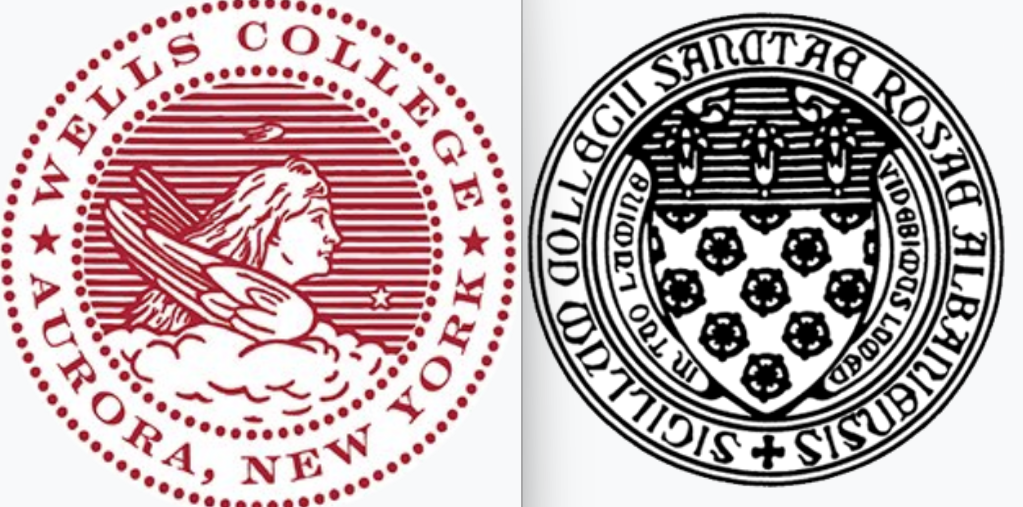
The Wells and St. Rose emblems.
It has been called the “Great Deaccession.” Many libraries find themselves drowning in books. They have lots of good books, but limited space. With books, unlike real estate, they are making more. Something's got to give. Out with the old, in with the new. If there are no takers, there is always the accepter of last resort, the dump.
Some colleges have been forced to deal with this overabundance, sometimes quietly, as their communities can be deeply offended by destroying books. However, this article is about a different issue that occasionally arises with college libraries, and it affects all of the library's books. The demographics of colleges are changing, which is to say, there aren't as many young people coming of age as there were in the past. There isn't as much demand for the colleges' services as there once was. Hit hardest are smaller, private colleges which need to charge very high tuition to stay afloat. Sometimes, they can't. The market isn't there. The college is forced to close its doors, leaving a library full of orphaned books. Two of these have recently been faced with this dilemma.
Wells College was a highly respected college in upstate New York. It was founded in 1868 and was a women's college until 2005. Going co-ed doubled the pool of potential “customers,” and Wells immediately saw a spike in enrollment, but in the years ahead it continued to slide. Covid's forced closure for a year was financially devastating to small colleges already in difficult straits. Nearby small colleges Cazenovia College and Medaille University were forced by financial challenges to close in 2023. Wells soon faced the same fate. Ultimately, the learning institution co-founded by Henry Wells was not able to survive the changing times as well as the other institution he founded, Wells Fargo. It closed in 2024 after over a century and a half in operation.
Its biggest asset, the campus, recently was sold to the Hiawatha Institute for Indigenous Knowledge, a non-profit devoted to preserving knowledge of Native American history, their leaders, language and culture, for $12.5 million. That left the personal property to be disposed of, which included the library books. We are not clear on how many are still there, but a couple of valuable books have been named, including a 1704 copy of Isaac Newton's Opticks, an illustrated Book of Hours from 1475-1500, and a first edition of Herman Melville's Moby Dick. The sale has been opposed by a group called the Wells Legacy Society, an organization formed shortly after the announcement of the college's closing. Their major objection is to the sale of items particularly related to local history. They argue that the sale of the campus generated more than enough money to pay their debts. Wells has petitioned a local court to permit the sale of remaining assets to go forward. Perhaps, logically, a compromise will be reached since Wells plans to give the excess funds resulting from the sale to charities, so why not give some of the personal property instead?
Another college forced to close its doors in 2024 also has a library book problem. The College of St. Rose in Albany, New York, also had a century-long run. St. Rose opened in 1920. It was founded as a Catholic college for women. Like Wells, it became coeducational, though much earlier, in 1970. While still connected to the Catholic Church, around that time it became independent. By then, the student body had expanded to include students of other faiths too.
During the first 15 years of the 21st century, St. Rose took on an aggressive expansion program. They gobbled up many nearby properties, tripling the campus size. They also spent a fortune upgrading the properties they purchased. They had to take on major debt to finance the expansion. However, during the second half of that period, enrollment declined. They were forced to put on the brakes. Programs were cut and so was faculty. Not surprisingly, the cuts brought about blow-backs from their community, but in the ensuing years, they had no choice but to continue cutting. It put off their day of reckoning, but did not stop it from coming. They closed after the spring semester of 2024, and that fall, St. Rose filed for bankruptcy. The campus was sold to the Pine Hills Land Authority to repurpose the property.
The library had many books still on the shelves. By large, we mean around 150,000. Most would be of limited value, but there are some that are significant. They haven't listed them, but they have books that go back to the 1600s, antique bibles, sheet music, academic periodicals and, obviously, a lot more. A one-by-one sale of these books might take longer than the lifetime of St. Rose so they have decided to make it easy. They are selling all 150,000 as one lot. My guess is they won't get much for them as there may be many books that have to be carted away at significant cost, but hopefully the valuable ones will more than make up for that. Bids were to be accepted through February 27, but that was too late for this publication. We should hear soon.